

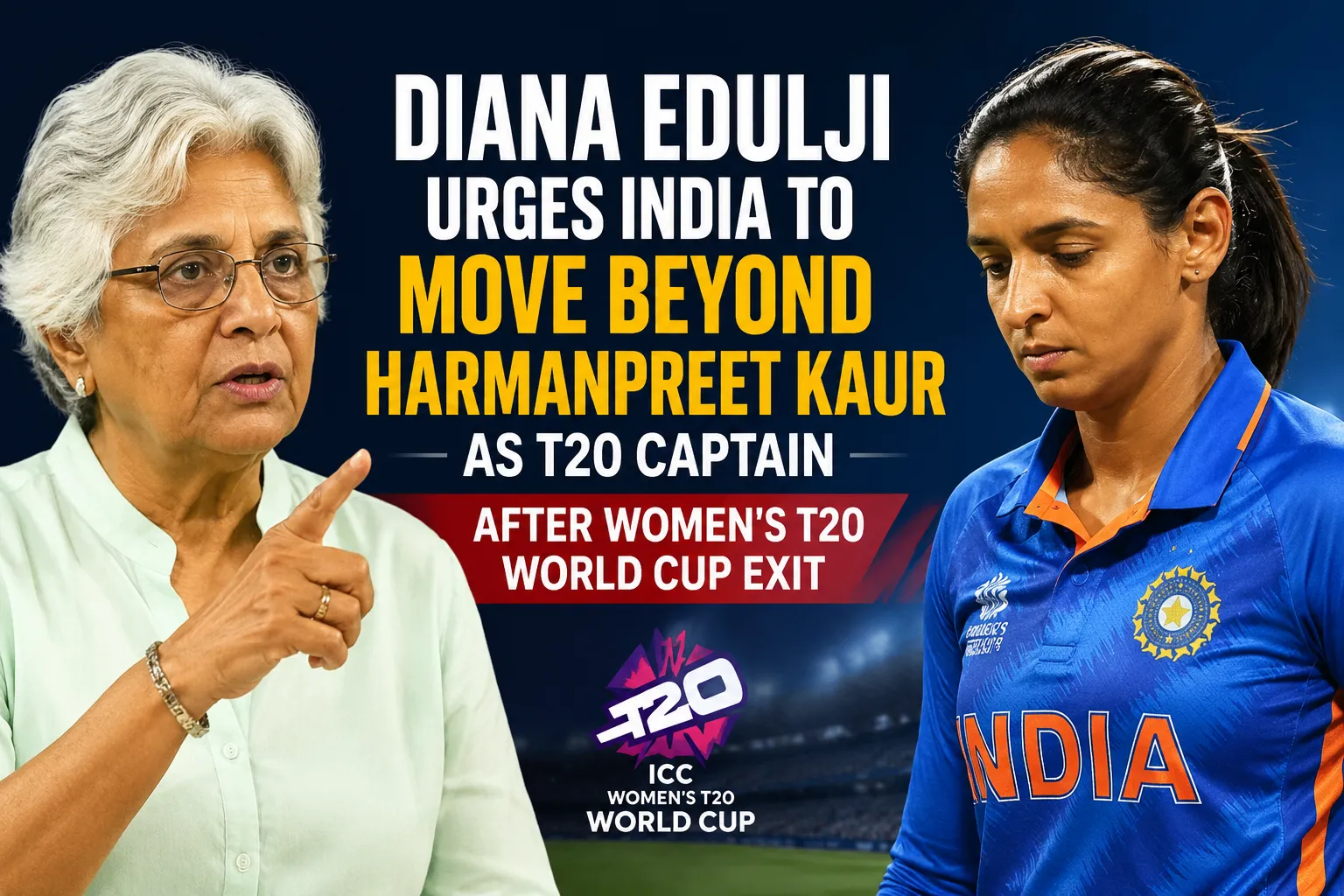
India’s disappointing exit from the 2026 ICC Women’s T20 World Cup has reignited debate over the future of captain Harmanpreet Kaur. Former India captain Diana Edulji believes the time has come for a leadership transition in the shortest format, arguing that Indian women’s cricket needs separate teams, captains, and coaching setups for T20Is and ODIs to remain competitive on the global stage.
Speaking after India’s second consecutive group-stage exit under Harmanpreet’s leadership, Edulji called for bold structural changes similar to those made in Indian men’s cricket. While backing Harmanpreet to continue leading the ODI side, she said a fresh captain and a specialized T20 setup could help India prepare better for future ICC events and the 2028 Los Angeles Olympics.
Diana Edulji Says It’s Time to Move Beyond Harmanpreet Kaur in T20 Cricket
Former India captain Diana Edulji believes India should appoint a new T20 captain following another disappointing Women’s T20 World Cup campaign.
Although the selectors have retained Harmanpreet Kaur as captain for the upcoming Asian Games, Edulji feels India must begin planning for the future by separating its ODI and T20 teams.
According to her, managing multiple formats places excessive physical and mental demands on players while also affecting fitness, fielding standards, and overall performance.
India’s T20 World Cup Campaign Ends in Disappointment
India failed to reach the knockout stage after suffering defeats against Australia and South Africa in the group phase.
The team defeated Pakistan, Bangladesh, and the Netherlands, but the losses to stronger opponents proved costly.
Harmanpreet finished the tournament with:
- 141 runs in 5 matches
- Average: 35.25
- Strike rate: 131.77
- One half-century
While her unbeaten 56 off 27 balls against Australia showcased her match-winning ability, Edulji believes greater consistency is needed from India’s captain.
Call for Separate Captains and Coaches
One of Edulji’s biggest recommendations is adopting separate leadership structures for different formats.
She suggested:
- Separate captains for ODIs and T20Is
- Different coaching staffs for both formats
- Specialized T20 player development programs
- Greater investment in skill-specific training camps
Edulji compared the situation to India’s bold decision in 2007, when MS Dhoni was appointed captain for the inaugural ICC Men’s T20 World Cup—a move that transformed Indian cricket.
Focus on Specialist T20 Players
Edulji also called for identifying players specifically suited to T20 cricket rather than expecting the same group to excel across all formats.
She highlighted aggressive batters such as Bharti Fulmali and Richa Ghosh as players who could become central figures in India’s future T20 plans with specialized training at the BCCI Centre of Excellence.
According to her, India needs to move away from playing T20 cricket with a 50-over mindset.
Harmanpreet Still Has a Role in ODI Cricket
Despite advocating a T20 leadership change, Edulji does not believe Harmanpreet’s international career should end.
She backed the veteran to continue leading India’s ODI side as the defending champions while acknowledging that the selectors must also prepare for the future, considering Harmanpreet will be nearing 40 by the 2029 Women’s ODI World Cup.
Edulji suggested that captaincy pressure may be preventing Harmanpreet from playing her naturally aggressive game.
Edulji Recommends Broader Changes for Women’s Cricket
Beyond captaincy, the former India skipper proposed several structural reforms aimed at improving Indian women’s cricket.
Her recommendations include:
- Developing more quality fast bowlers capable of replacing legends like Jhulan Goswami
- Making domestic cricket mandatory for India’s top women cricketers
- Increasing boundary sizes in the Women’s Premier League (WPL) to match international standards
- Conducting specialized camps for batting, bowling, fielding, catching, and wicketkeeping
- Expanding India’s pool of wicketkeepers beyond Yastika Bhatia
She also emphasized the need for greater involvement from former India players in shaping the women’s team’s long-term development.
What This Means for India’s Future
Edulji’s comments come at a crucial stage for Indian women’s cricket.
With the Asian Games approaching and qualification already secured for the 2028 Los Angeles Olympics, discussions around leadership and squad planning are expected to intensify.
While Harmanpreet remains one of India’s most influential cricketers, growing calls for a fresh T20 leadership structure suggest the team could be entering a period of transition.